
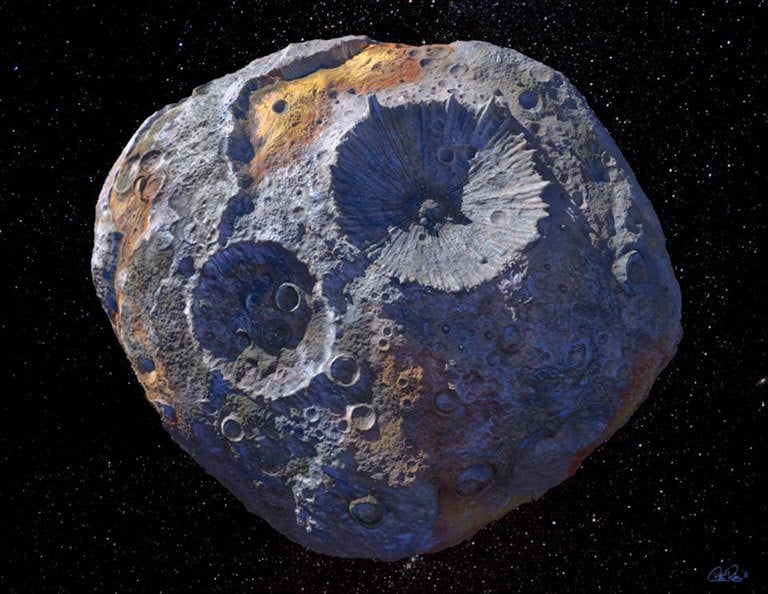
A space object with the name (16) Psyche has everyone at NASA excited. This massive metallic asteroid is thought to be pure iron and nickel. With a size of 200 km (130 miles), it’s one of the 10 most massive bodies in the asteroid belt. If we could somehow mine it it is worth approximately $10,000 quadrillion. However that’s not the main aim of NASA’s planned mission. NASA hopes exploration will help futher our understanding of the solar system. It’s distance from Earth is --,---.
Where is Asteroid (16) Psyche now?
Space in 3D Web App
Currently Psyche is --,--- from earth, racing through the solar system at --,--- (--,---) . It is getting --,--- --,--- earth every second.
Scientists wonder if Psyche is the core of a planet just like earth that broke apart after a series of collisions, leaving only the core intact. With a space craft equipped with a magnetometer, multi-spectral camera, gamma ray and neutron spectrometers and laser technology, scientists want to gather as much information as possible about this mysterous object. It may increase our understanding of our own planet as well as it’s nigh impossible to get to Earth core, buried under 2,800 km of rock.
Since midnight last night it got --,--- --,--- us. Since you started looking at this page it is --,--- --,---.
How fast is Psyche going?
The asteroid that NASA has to hunt down is moving about the sun at a speed of --,--- (--,---). Compare 16Psyche to Earth, which is rushing around the sun at --,--- (--,---).
Check out the simulation above, where you can observe and track the orbit of (16) Psyche, and explore the solar system.
When does the mission start?
NASA’s asteroid mission has received approval to enter the final design stage before manufacturing. Launch is scheduled for 2022.
*This Interactive 3D Simulation is built on data provided by NASA JPL HORIZONS database for solar system objects and International Astronomical Union’s Minor Planet Center. Distances and speeds are estimates based on this data.
Photo Credit and other: NASA, ESO/S. Brunier, NASA/JHUAPL/SwRI, NASA/JPL-Caltech, JAXA, University of Tokyo & collaborators, UH/IA, Solar System Scope/INOVE CC BY 4.0, Wikipedia/Creative Commons Attribution-ShareAlike License, icons8.com, Péter Eke, NASA/Goddard/University of Arizona/Roman Tkachenko, Wikimedia Commons, Hayabusa 2 Arrival illustration by Akihiro Ikeshita (permission granted), oNline Web Fonts, Font Awesome, Galaxy vector created by stories – www.freepik.com